
Joseph Nechvatal’s Immersive Noise Theory
by
Yuting Zou
Published in The
Brooklyn Rail
April Issue 2011

http://www.brooklynrail.org/2011/04/books/nechvatals-immersive-noise-theory
Joseph Nechvatal
Immersion Into Noise
University of Michigan Library’s Scholarly Publishing Office
in conjunction with Open Humanities Press, 2011
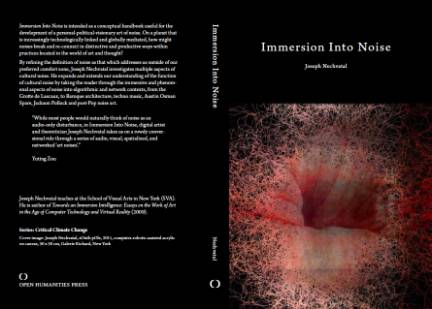
Immersion Into Noise [Paperback]
by Joseph Nechvatal available for purchase
@
http://www.amazon.com/Immersion-Into-Noise-Joseph-Nechvatal/dp/1607852411
While most people would naturally think of noise as an audio-only disturbance, in Immersion Into Noise, digital artist and theoretician Joseph Nechvatal takes us on a rowdy conversional ride through a series of audio, visual, spatialized, and networked “art noises.” He supports his argument with examples from the history of philosophy, noise music, the visual arts, architectural history, network theory, and consciousness studies.
In his introduction, Nechvatal discusses his perception of noise as the material for an immersive art that allows the mind to connect to the body through what he calls a “self-attentive unification,” as the excess of art noise triggers intensities in all directions. His argument places emphasis on immersion, which implies a continuum of intensity vectors, the integration of which preconditions “the ecstasy of going outside of self” without losing connection with the self. Nechvatal details his visit to a site of “immersive noise vision” within a little known, rarely seen space in the prehistoric cave, Lascaux, as a personal, and powerful, example of the kind of experience he is arguing for in the book.
In the conclusion of Immersion Into Noise, Nechvatal hypothesizes an innovative theory that he calls “immersive noise consciousness.” This theory proposes that the function of an “immersive art-of-noise” is to provide us with an artistic environment of clamorous cultural information capable of expanding our consciousness, disjunctively. He further concludes that this disjunctive noise consciousness may lead to a new ontological unification based in “self-re-programmablity.” Nechvatal maintains that the “subsequent and ultimate aesthetic benefit of noise art then, is in attaining a prospective realization of our perceptual circuitry as a self-re-programmable operation.” He feels that our learning to self-modify (self-re-program) ourselves is the entire point of art.
According to Nechvatal, in our age of “massive electronic deluge,” we are constantly immersed in an information-overloaded virtual world of distributed networks. Art noise in this culture, as conceptualized by Nechvatal, “distorts and disturbs crisp signals of cultural communications.” Unlike normal noise, which doesn’t mean anything, aesthetic art noise, according to Nechvatal, is full of cultural meanings and becomes a dense, confusing assemblage of cultural ideologies and signifiers. Hence, according to Nechvatal, “art noise” as virtual environment can be considered a miniscule abstraction of our larger noisy, connected world. While immersed in a “noise art environment,” the “immersant” is stimulated to experience a paradoxical (and disjunctive) state of connectivity and disconnectivity. The neural networks of the human body join with the external, noisy art networks and form a body-space of “hyperconnectivity.” Thus, the classical, ontological body partially dissolves in an art-of-noise virtual environment, collapsing the distinction between the inside and the outside.
However, noise is disturbing and offensive. It is beyond comprehension and challenges our habitual way of thinking and reasoning. Noise necessarily produces resistance in the mind, creating a “critical distance” via a “body/mind rupture.” But Nechvatal intends not only to make us aware of our inner ruptures. He too proposes that the “excess” inherent in the “art of noise” offers an expansive, “saturating border experience.” By increasing art noise to that threshold, the superabundance of “ideological demonstration becomes non-representational.” Therefore, such a noise art environment becomes a private vacuole (noncommunicational cocoon) of self-reflection, where a newfound depth of self-understanding is achieved, as well as a disillusionment of social spectacles and ideologies.
Nechvatal’s immersive noise theory is deeply rooted in contemporary philosophy, particularly Deleuze and Guattari’s A Thousand Plateaus, in which the two philosophers describe the condition of a body without organs as an insubstantial state of connected-being that lies beyond representation. Nechvatal also draws on their concept of “becoming-animal,” which emphasizes movements of escape that cross thresholds to reach a continuum of intensities where all forms come undone. In a becoming-animal noise panorama, a feedback-loop is used as a metaphor for a psychic bouncing-back-and-forth from comfort to distress (and loops). Nechvatal builds on these ideas when postulating noise art environments that are capable of pushing the limits of our habitual significations, signifiers, and signifieds—to the benefit of a new unformed state of de-territorialized flux.
Georges Bataille is Nechvatal’s other major influence, including his definition of excess as not so much a surplus, but as an effective passage beyond our established limits, an impulse that exceeds even its own threshold. Also considered is the French philosopher Michel Serres’s interrogation of the idea of noise in his books Genèse and The Parasite, as well as Derrida’s deconstruction of logocentrism: the once held distinction between subjectivity and objectivity. Nechvatal builds his noise theory on solid ground by judiciously using contemporary philosophical concepts, such as fractals, quantum mechanics, Brownian random walk, and differential structure. He then ties in Eastern philosophy (Zen and I Ching) through John Cage’s developed aesthetic theories, which lead to an abandonment of structure in favor of structures that become indeterminate via chance operations. Cage concluded that, even though it has certain uses, structure is unnecessary. One wonders just what kind of noise art dynamics might be generated by the heterogenic intersection of the all-embracing Tao and the promising unification of physics superstring/M-theory (our most ambitious attempt at a unification theory): Would it be interesting to have such an all-inclusive philosophy that allows for both self-referential differential structure and axiomatic algebraic structure? But for now, Nechvatal’s theory of noise art aims at a self-referential mode in an immersive environment, a representation of what he calls a “conspicuously excessive, connected and collapsing society.” An immediate benefit of Nechvatal’s noise theory of “rupture-induced expansion” is its emphasis on that which “unites the apparent opposites of subjectivity and objectivity” in the interests of a networked well-being from a connectionist perspective.
Generously sharing his intimate experiences at Lascaux, Nechvatal guides us through a sequence of cavernous shelters, labyrinthine passages, and excessively decorated architectures. None of them is constructed as an ideal linear space. They are all irregular and unpredictable places that induce us to experience a “compressed, close-up immersive experience.” As he poetically puts it, we enter with him “the depths of the immersive darkness to contemplate both the beginning and end of life.” Or, as he more analytically puts it, “it is in the cave, generally deep within, where early immersive art attained its maximum intensity.” This noise aesthetic of holes and caves is often exemplified in Nechvatal’s own digital art, with its use of an artificial-life computer virus program that enters and eats away his digital paintings of human retinas and anuses.
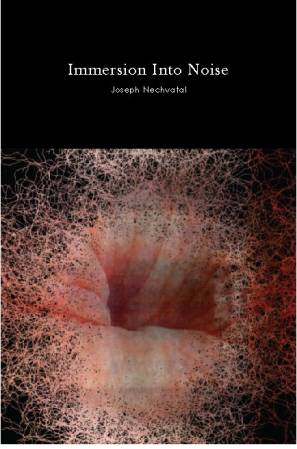
Immersion Into Noise
by
Joseph Nechvatal
Critical Climate
Change
On-line HTML version
and PDF download
@
http://openhumanitiespress.org/immersion-into-noise.html